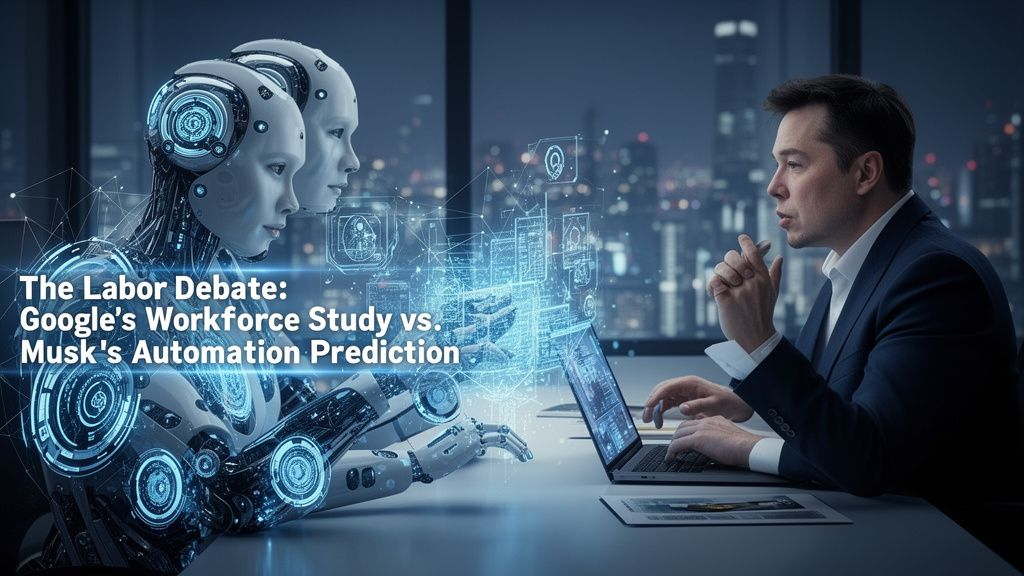
TL;DR: This comparative review analyzes two opposing perspectives on the future of employment, contrasting a practical task-based study by Google that highlights AI as a worker aid with Elon Musk’s long-term prediction of total human labor obsolescence.
Introduction: The Competing Futures of Human Labor
The rapid advancement of artificial intelligence has sparked a fierce debate among economists, corporate leaders, and technology visionaries regarding the future of the global workforce. As organizations deploy complex language models, predictive analytics, and automated decision-making engines, the core question remains: will artificial intelligence serve as an empowering assistant to the human worker, or will it ultimately automate human labor out of existence?
To understand this landscape, we must examine two highly prominent, yet fundamentally divergent, viewpoints. The first is a rigorous, empirical study conducted by Google (reported by the Wall Street Journal) which presents a reassuring, collaborative outlook. The second is a disruptive, speculative vision championed by Tesla and SpaceX founder Elon Musk, who warns of absolute human labor displacement.
The Google Study: Task-Based Assistance and Worker Support
According to a study conducted by Google, the widespread anxiety that artificial intelligence will rapidly automate away human jobs is largely misplaced. Rather than acting as a direct replacement for human employees, Google’s research indicates that AI is actively helping workers optimize their daily performance.
Empirical Methodology and Task Analysis
The foundation of Google's study lies in its detailed task-based methodology. Rather than evaluating entire occupations as single, indivisible units of labor, researchers broke down various jobs into their constituent tasks. They then analyzed which specific tasks could be successfully performed or accelerated by artificial intelligence.
The findings reveal that while AI is highly capable of automating specific repetitive, data-heavy, or routine sub-tasks, it is unable to replicate the complex problem-solving, emotional intelligence, and strategic decision-making that define the core of most professional roles. Consequently, the study concludes that AI acts as an assistant rather than a replacement. By automating time-consuming administrative duties, the technology allows human workers to focus their energy on high-value, creative responsibilities, thereby enhancing job performance and overall operational productivity.
Elon Musk's Perspective: The Horizon of Total Human Obsolescence
In stark contrast to Google’s supportive, collaborative framework, technology entrepreneur Elon Musk offers a far more radical outlook on the trajectory of artificial intelligence. Musk has repeatedly warned that the ultimate capabilities of artificial intelligence will eventually render traditional human labor obsolete.
Exceeding the Sum of Human Intelligence
Musk asserts that "there really won't be anything that AI can't do better than humans." According to his perspective, the exponential development curve of machine learning models suggests that artificial intelligence will not remain confined to supporting roles or simple task automation. Instead, Musk projects that artificial intelligence may eventually exceed the combined sum of all human intelligence.
In this scenario, the traditional concept of work would undergo a fundamental transformation. If autonomous systems can perform every physical and cognitive task more efficiently, accurately, and cost-effectively than human workers, the economic incentive to employ humans would disappear. This perspective shifts the conversation away from incremental productivity gains and focuses on the massive societal, economic, and ethical challenges of managing a post-labor world.
Reconciling the Dual Narratives: Incremental vs. Exponential
Reconciling these two viewpoints requires understanding the different timescales and methodologies driving each perspective:
- The Tactical Present (Google): Google’s study is grounded in current empirical market realities and immediate technological limits. It provides businesses and policymakers with a practical guide to managing the current workforce, demonstrating that today's AI tools are most effective when paired with human expertise.
- The Strategic Future (Musk): Musk’s predictions are based on an exponential view of technological growth, looking past current engineering bottlenecks toward a hypothetical future where artificial general intelligence (AGI) is fully realized.
While Google's findings offer reassuring, actionable guidance for contemporary workforce integration, Musk's warnings highlight the critical need for long-term planning, safety governance, and societal preparation.
Key Takeaways
- AI as a Collaborative Tool: Google's empirical research indicates that AI's primary impact is task assistance, helping workers save time on routine administrative duties rather than replacing their entire roles.
- The Specter of Superintelligence: Elon Musk’s long-term projection warns that AI will eventually exceed the sum of human intelligence, making total job replacement a technical possibility.
- The Importance of Task Breakdown: Analyzing jobs by their individual tasks, rather than treating occupations as monolithic, is essential for accurately measuring the true economic impact of automation.