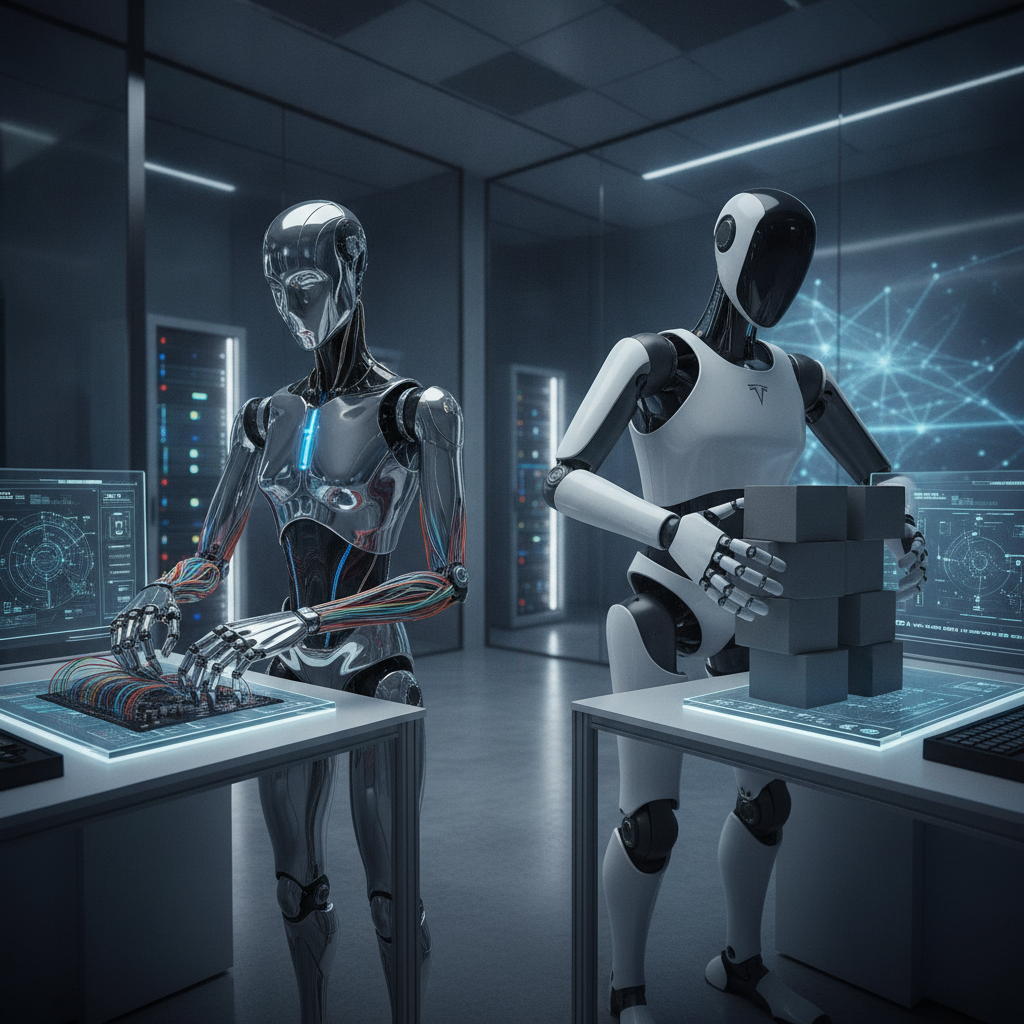
Comparing the Hand Dexterity of 1X NEO and Tesla Optimus
TL;DR: The 1X NEO robot hand uses a compliant, tendon-driven system designed for safe, soft human interaction, whereas Tesla's Optimus Gen 2 hand relies on rigid actuators with integrated tactile sensors for high-precision manipulation. While 1X prioritizes natural compliance and safety in residential settings, Tesla focuses on scaling mechanical force and high degrees of freedom for industrial throughput.
The physical capabilities of humanoid robots depend heavily on their end-effectors. See our Full Guide to understand how 1X Technologies designs its hardware to replicate human capability. 1X Technologies uses a tendon-driven, compliant approach in its NEO Beta humanoid robot, contrasting with the rigid-body actuation system found in Tesla's Optimus Gen 2. This technical comparison analyzes how these design philosophies affect grasp mechanics, safety, payload capacity, and real-world deployment.
How does the mechanical design of 1X NEO hands differ from Tesla Optimus?
The 1X NEO robot hand differs from the Tesla Optimus by using a gearless, tendon-driven design that mimics human muscles, whereas the Tesla Optimus Gen 2 uses rigid metal links powered by brushless DC motors and mechanical actuators.
1X Technologies designs its NEO humanoid with compliance in mind. The hand uses high-strength ropes instead of rigid gears, allowing the fingers to bend and yield when they encounter physical resistance. This passive compliance means the hand absorbs impact energy naturally, reducing the risk of damage to the robot or its environment. This design reflects its primary use case: working safely alongside humans in homes. The gearless direct-drive motors combine with low-friction cable conduits to allow back-drivability. If you push against the NEO hand, it yields under pressure rather than resisting with rigid force.
In contrast, Tesla’s Optimus Gen 2 hand uses a rigid kinematic chain. Tesla's design houses the actuators in the forearm, pulling metal tendons to actuate the fingers. While this rigid setup offers precise positioning, it relies entirely on software-controlled active compliance to avoid damage during collisions. For 2026, Tesla is upgrading Optimus to a 22-degrees-of-freedom (DoF) hand, up from the 11-DoF hand shown in 2024, to double its mechanical articulation. This upgrade allows Optimus to perform complex industrial tasks, such as handling small fasteners and routing cables, which require rigid stability and fine-grained motor control.
Which robot hand offers better tactile sensing and feedback?
Tesla's Optimus Gen 2 hand offers superior tactile sensing through integrated sensor arrays on all fingertips, while the 1X NEO relies primarily on motor current monitoring and force-torque sensors to estimate grasp pressure.
Tesla integrates custom tactile sensors directly into the finger pads of the Optimus Gen 2. These sensors measure contact pressure and shear force in real time, allowing the control system to adjust grasp strength instantly. This feedback loop prevents Optimus from crushing fragile objects, like eggs, during pick-and-place tasks. The sensors send high-speed signal data to the main processor, allowing the AI model to learn the physical properties of objects through touch. This capacity is essential for industrial logistics where part weights and textures vary.
The 1X NEO hand takes a different approach to force sensing. Because the NEO uses compliant tendon actuators, the system measures tension along the cables and monitors the electrical current drawn by the motors. This proprioceptive feedback allows the robot to feel resistance across the entire hand rather than just at localized sensor points. While this makes the 1X NEO hand resilient, it lacks the fine spatial resolution of Tesla's dedicated tactile arrays for identifying surface textures. For tasks like folding laundry or carrying groceries, global physical compliance is more useful than localized touch sensors.
How do compliance and safety compare in real-world environments?
The 1X NEO provides superior passive safety because its soft, tendon-driven hands cannot exert rigid crushing force, whereas the Tesla Optimus requires active sensor loops to remain safe around humans.
Passive safety is built into the physics of the 1X NEO. If a person bumps into a moving NEO hand, the fingers naturally deflect, mitigating the risk of injury. 1X Technologies specifically engineered this behavior to make NEO suitable for residential care and home assistance. The robot weighs only 30 kilograms, and its soft exterior matches the compliant mechanics of its hands. Because the system does not rely on software to stop a motor during an impact, there is no latency risk in human-robot interactions.
Tesla’s Optimus is a much heavier machine, weighing approximately 57 kilograms. Its rigid metal hand structure can exert significant force. To ensure safety, Tesla utilizes high-speed control loops that read sensor data and stop motor movement when unexpected resistance is detected. This active safety model is highly effective in structured industrial environments, such as Tesla's Gigafactories, where robots perform repetitive assembly tasks. However, it introduces latency risks that passive compliance entirely avoids. For business leaders, this makes 1X NEO the preferred choice for collaborative public environments, while Optimus is suited for heavy industrial deployment.
Key Takeaways
- 1X NEO uses a gearless, tendon-driven system that provides passive compliance, making it safer for home environments.
- Tesla Optimus Gen 2 features advanced tactile sensors on all fingertips, enabling precise manipulation of fragile objects.
- Tesla is expanding Optimus to a 22-DoF hand in 2026, aiming to match human manual dexterity for complex manufacturing tasks.