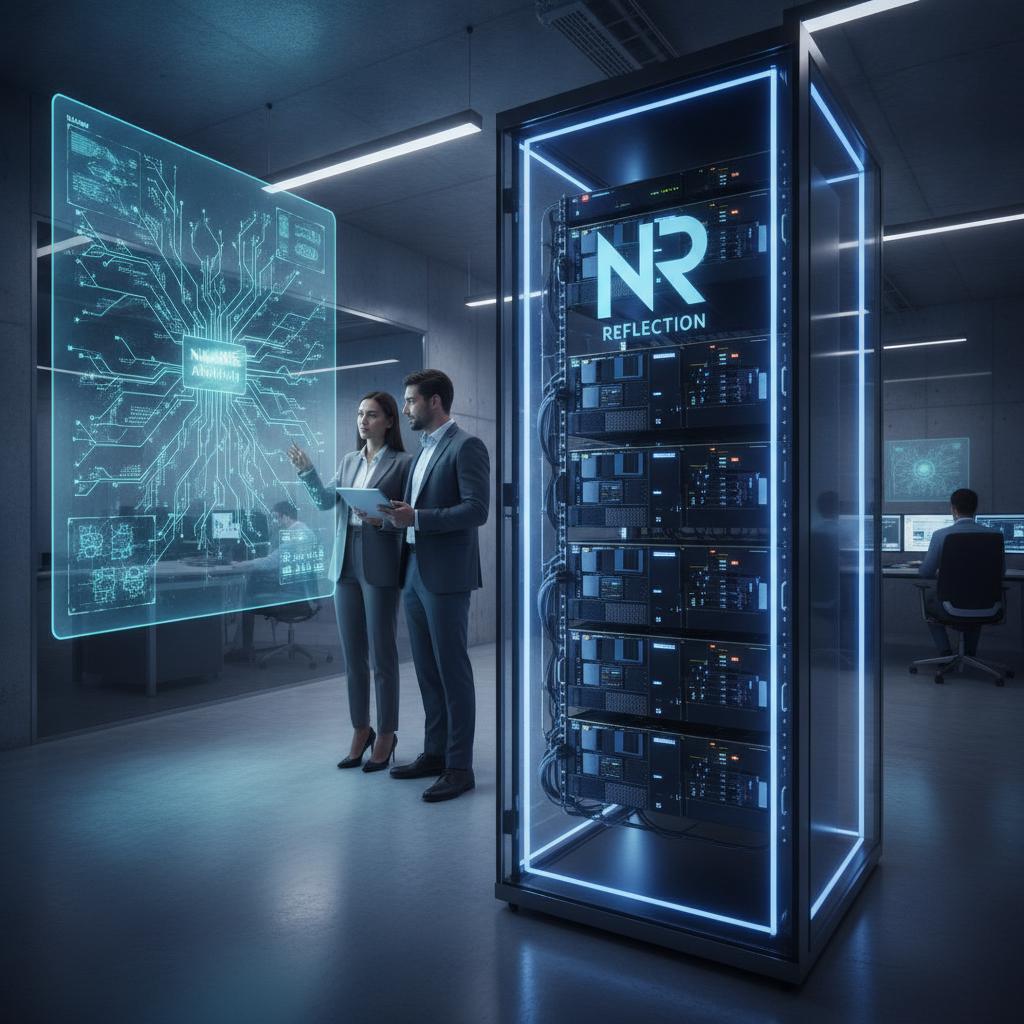
TL;DR: Reflection's multi-year, billion-dollar agreement for Nebius compute resources provides the raw GPU capacity needed to train its next-generation artificial intelligence models. By securing direct access to high-performance NVIDIA H100 and Blackwell clusters, Reflection eliminates the primary infrastructure bottleneck hindering large-scale model pre-training and iterative fine-tuning.
Global business leaders increasingly see computational power as the primary differentiator in the generative artificial intelligence market. Reflection's strategic partnership with Nebius Group addresses this challenge head-on. See our Full Guide on how this deal positions both companies to compete with legacy hyperscalers. Through this partnership, Reflection secures dedicated access to high-performance GPU clusters, bypassing the public cloud queues that delay model training cycles. By moving workloads to Nebius's highly optimized, specialized AI cloud, Reflection can focus resources on architectural design and data curation rather than infrastructure management.
How does the Nebius compute deal accelerate Reflection's model training?
The Nebius compute agreement accelerates Reflection's model training by providing guaranteed, low-latency access to thousands of interconnected NVIDIA GPUs configured specifically for large language model workloads. This dedicated access prevents the scheduling delays common on multi-tenant public clouds. By avoiding queue times, Reflection can run continuous training epochs and rapidly validate architectural changes.
Eliminating Virtualisation Overhead with Bare-Metal GPUs
Traditional cloud providers run virtual machines that add hypervisor overhead, reducing GPU utility by 5% to 10%. Nebius delivers bare-metal instances that let Reflection run training workloads directly on the hardware. This architecture maximizes floating-point operations per second (FLOPS) and speeds up the training of dense parameters. The direct hardware access ensures that Reflection's proprietary training code executes with maximum efficiency, cutting total training time. By running directly on the hardware, Reflection avoids noisy-neighbor issues common in shared public clouds, where other tenants' workloads degrade network and storage performance.
High-Speed Interconnects Reduce Synchronization Bottlenecks
Multi-node training requires massive data exchange between GPUs during the backward pass of backpropagation. Nebius uses NVIDIA Quantum-2 InfiniBand networking with speeds up to 400 Gbps per port. This network topology minimizes latency and maximizes throughput across thousands of nodes. It reduces the time GPUs spend waiting for gradient updates, keeping compute utilization high throughout the entire run. This high interconnect speed is necessary for training large transformer architectures where model weights must be distributed across multiple GPU memories using tensor and pipeline parallelism.
Why is dedicated GPU capacity critical for Reflection's 2026 roadmap?
Dedicated GPU capacity is critical for Reflection's 2026 roadmap because it allows the company to run continuous pre-training runs and reinforcement learning loops without scheduling delays or spot-instance interruptions. Advanced frontier models require months of uninterrupted computational power to converge. Securing a multi-year, billion-dollar commitment ensures that Reflection's research team can schedule major training runs well in advance.
Facilitating Reinforcement Learning from Human Feedback at Scale
Training next-generation models requires complex alignment techniques, including Reinforcement Learning from Human Feedback (RLHF) and Direct Preference Optimization (DPO). These methods demand concurrent runs of actor, critic, and reference models, tripling the memory footprint. Dedicated clusters ensure these resource-heavy pipelines run concurrently without resource starvation, enabling faster alignment and better reasoning performance.
Scaling Up to Hundreds of Billions of Parameters
To achieve better reasoning capabilities in 2026, Reflection plans to scale its model architectures beyond current limits. Moving from 70-billion-parameter configurations to mixture-of-experts (MoE) architectures with hundreds of billions of parameters requires petabytes of distributed memory. Nebius’s clustered infrastructure provides the physical memory capacity and high-bandwidth memory (HBM3e) options to split these massive models across hundreds of nodes without hitting memory wall bottlenecks. This ensures that even the largest parameter sets can be updated synchronously across the cluster without data starvation.
How does Nebius infrastructure lower the cost of model iteration?
Nebius infrastructure lowers the cost of model iteration by offering highly optimized power usage and custom cooling designs that reduce the total cost of ownership per training run. High-performance computing demands extreme power density, which translates to high utility costs. By leveraging Nebius's custom-engineered facilities, Reflection reduces the direct cost of energy consumed during massive pre-training phases.
Energy Efficiency in European Data Centers
Nebius operates highly efficient data centers, including its flagship facility in Mäntsälä, Finland. This facility uses natural free cooling and recovers waste heat for the local municipal heating network, achieving a Power Usage Effectiveness (PUE) rating far below the global industry average of 1.58 reported by the Uptime Institute in 2023. Lower power overhead translates directly to lower per-hour GPU costs for Reflection, stretching their billion-dollar compute budget further.
Streamlined Software Stack and Orchestration
Nebius provides a pre-configured software environment optimized for NVIDIA's Megatron-LM and PyTorch frameworks. This integration reduces the engineering hours Reflection must spend on low-level system debugging. Instead of managing Kubernetes configurations, network drivers, and CUDA dependencies, Reflection engineers can deploy training jobs with a single command. This automation speeds up the iterative feedback loop, allowing engineers to test new tokenization strategies or dataset mixtures in hours rather than days. Additionally, built-in health checks automatically detect and isolate failing GPUs during long training runs, preventing costly job crashes.
Key Takeaways
- Guaranteed Infrastructure Availability: The billion-dollar agreement secures dedicated access to NVIDIA H100 and Blackwell GPUs, protecting Reflection from market-wide hardware shortages.
- Architectural Performance Gains: Bare-metal deployments combined with 400 Gbps InfiniBand interconnects eliminate virtualization and synchronization overhead, accelerating training cycles.
- Operational Cost Reduction: Leveraging energy-efficient European data centers with low PUE ratings helps Reflection maximize its computational output per dollar spent.